
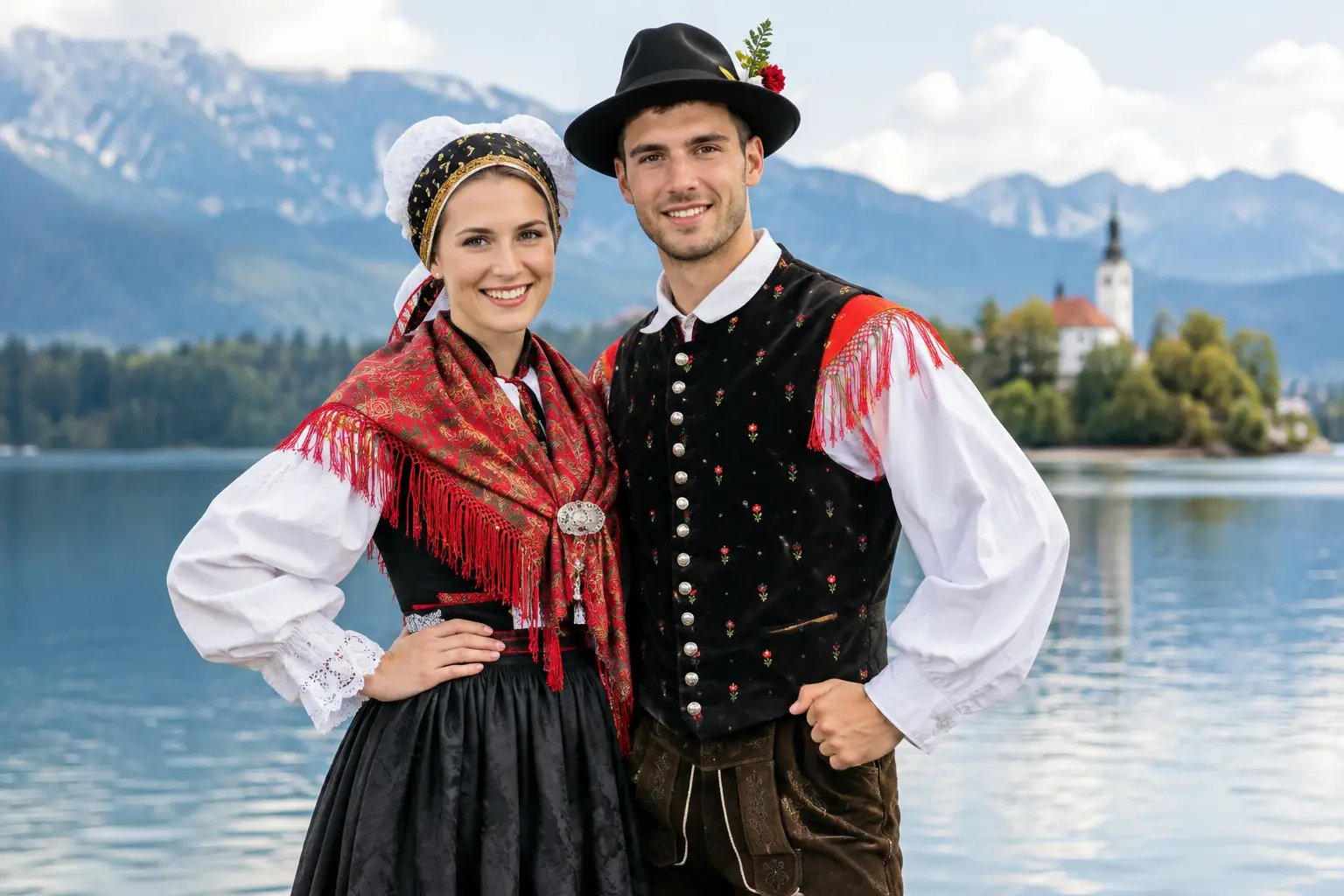
A Slovenian folk costume is not simply a colorful outfit for the stage. It can tell you where a dance comes from, what kind of work shaped a community, and how people once marked Sunday, holidays, weddings, and village celebrations. This Slovenian folk costumes guide helps you look beyond the embroidery and enjoy the stories woven into every skirt, hat, vest, and apron.
For visitors, the joy is in seeing these traditions in motion. A costume becomes most meaningful alongside the quick rhythm of a polka, the turn of a circle dance, a toast of local wine, and a room full of people ready to clap along. Slovenia may be small, but its regional character is wonderfully rich.
Folk costumes are regional, not one national uniform
Slovenia has a strong national identity, yet there is no single folk costume worn in exactly the same way across the country. Traditional dress developed locally, shaped by climate, trade, faith, farming, nearby borders, and the prosperity of each area. The clothing seen at folklore performances is generally based on historic village dress, carefully adapted and maintained so the tradition can be shared today.
You may notice a common visual language: white linen shirts, full skirts, fitted bodices, decorated aprons, dark vests, hats, boots, and handkerchiefs. But the details matter. A trim, a head covering, a fabric choice, or the way an apron is tied may point toward a particular region.
Costumes also changed over time. Everyday work clothing needed to be practical and durable, while festive clothing used finer fabrics and more decoration. Wealthier households could afford silk ribbons, velvet, jewelry, or carefully made boots. That is why the most striking outfits should not be read as everyday historical wear for every person.
The key pieces you will see
Women’s dress: aprons, bodices, and headwear
Women’s folk costumes often create the most memorable silhouette. A white blouse is commonly paired with a long, gathered skirt, a fitted bodice or vest, and a decorative apron. Aprons were useful garments in daily life, but in festive dress they became a place for color, pattern, and fine detail.
Headwear is especially revealing. Depending on the region and period, a woman might wear a scarf, bonnet, cap, or floral arrangement. In some traditions, the style could reflect age or marital status. Do not assume that every flower crown is an old village custom, however. Modern performances may use festive styling that reads well on stage while respecting regional inspiration.
Shawls, ribbons, stockings, and jewelry complete the look. The overall effect is graceful, but these clothes were also made for social life: walking to church, gathering for a feast, and dancing with neighbors.
Men’s dress: shirts, vests, trousers, and hats
Men’s costumes often combine a bright white shirt with a dark vest, trousers, a sash, and sturdy footwear. The vest may be embroidered or finished with decorative buttons, particularly for a special occasion. Hats vary widely, from felt styles to caps associated with particular local traditions.
A man’s costume can look simpler at first glance, but it carries its own signals of region and status. A neck scarf, belt, jacket cut, or hat shape changes the whole character of the outfit. During fast dances, the clean contrast of white shirts, dark vests, and moving hats makes the choreography easy to follow.
Footwear and accessories matter too
Leather shoes and boots were built for real village roads and changing weather, not only for photographs. Handkerchiefs, scarves, belts, necklaces, and ribbons add another layer of meaning and movement. When dancers spin, these small details come alive.
A quick regional tour through Slovenian dress
The most enjoyable way to understand Slovenian folk costumes is to think of them as a map you can see. Northern Alpine areas, central Slovenia, the Karst, the coast, and eastern regions each bring their own character.
In the Alpine northwest, traditional clothing often feels more formal and structured, reflecting mountain communities and connections with Central European dress. You may see darker woolen elements, tailored jackets, and hats suited to cooler conditions. The Gorenjska region is particularly well known for folk imagery that many visitors recognize as classically Slovenian.
Central Slovenia, including the wider Ljubljana area, offers its own variations shaped by market towns and rural communities. Here, costumes may balance practical village clothing with festive refinement. The capital is a natural place to encounter styles from across the country because performers bring regional traditions together for visitors and local audiences.
Toward the Karst and the coast, Italian and Mediterranean influences appear in materials, colors, and styling. Eastern Slovenia, including areas such as Prekmurje and Styria, brings other rhythms and dress traditions, influenced by neighboring Hungarian and Austrian cultural worlds. The result is not a costume collection that fits into neat boxes. It is a living patchwork, and that variety is the point.
What colors and details can tell you
Bright color is often what catches the eye first, especially red accents, patterned ribbons, floral motifs, and richly decorated aprons. Yet folk dress is not always bright. Some historic garments are restrained, using natural linen, wool, black, brown, white, or deep blue. The festive version may be more elaborate than the clothing worn for ordinary tasks.
Embroidery can signal care, skill, and celebration. Lace and pleating show the labor invested in a garment. Fine details were often passed through families or made locally by people who knew the materials, techniques, and customs of their area.
It is tempting to assign one fixed meaning to every color or symbol, but tradition is rarely that simple. The same motif may appear in different places for different reasons. A good performance or guide provides context rather than turning every ribbon into a secret code.
How to enjoy folk costumes respectfully
Visitors are warmly welcome to admire, photograph, and ask about Slovenian traditional dress when the setting allows it. The best approach is simple: treat the performers as people sharing a cultural tradition, not as props in a souvenir photo.
If a participatory evening invites you to dance, join in. You do not need to know the steps perfectly. Folklore is built around community, and a little laughter is part of the experience. If costumes are available for guests to try, follow the host’s guidance and enjoy the moment without treating the clothing as a joke.
For photographs, wait for a natural pause or ask first, especially when performers are preparing, eating, or speaking with other guests. Avoid pulling at accessories, hats, ribbons, or embroidery. Many costume pieces are handmade, carefully repaired, or difficult to replace.
Why costumes belong with music, food, and dancing
A costume behind glass can be beautiful, but it offers only one part of the story. Slovenian traditions make more sense when they are shared around a table. The songs set the mood, the dances reveal the energy of a region, and the food gives guests another direct connection to local life.
That is why a festive folklore evening can be such a memorable introduction for first-time visitors. At Traditional Slovenian Evening in Ljubljana, costumed performers, live music, regional dances, traditional food and wine, stories, and guest participation create a celebration rather than a lecture. You may arrive curious about the outfits and leave remembering the dance you tried, the toast you shared, and the people at your table.
Your Slovenian folk costumes guide: what to remember
The most useful thing to remember from this Slovenian folk costumes guide is that traditional dress carries both history and hospitality. It represents local pride, but it is also meant to be seen, heard, and enjoyed in company. Look closely at the regional details, ask a question when you have the chance, and let the music do the rest.
When the first notes begin and the dancers step onto the floor, do not stand back too long. Raise your glass, join the applause, and let Slovenia welcome you the traditional way: with warmth, generosity, and a little dancing.